Method / Circular Deduction
Structure the consequential decision.
Frame → Derive → Contradict → Reconcile → Commit → Extract govern the decision. The separate +1 Reinsert state governs what validated learning is authorized to change.
People and systems contribute evidence. Circular Deduction structures the review. Human Authority controls consequential commitment.
Explore a synthetic demonstration or discuss a separately scoped engagement.
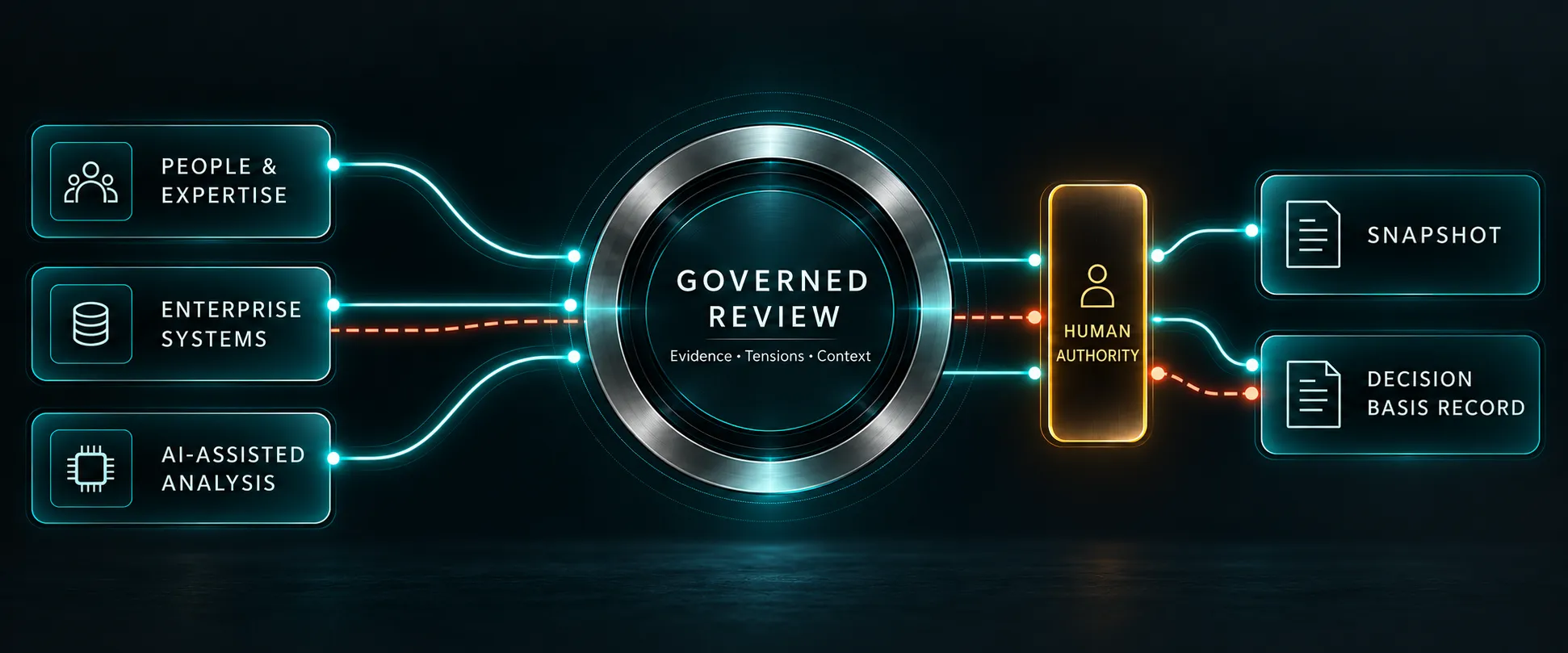
Conceptual illustration. Human Authority records the disposition. Snapshot and Decision Basis Record preserve the basis.
Coral dashed: unresolved and retained. HOLD remains possible. No approval is implied.
01 / System roles
Select a role to inspect its contribution and boundary. These explanations grant no decision authority.
Method / Circular Deduction
Frame → Derive → Contradict → Reconcile → Commit → Extract govern the decision. The separate +1 Reinsert state governs what validated learning is authorized to change.
Operating and governance architecture / ECOS
ECOS provides the governed decision environment: evidence state, applicable requirements, identified governing versions, authority context and review conditions. Decision Review is its governance and verification subsystem.
Common operating surface / Decision Cockpit
The Cockpit presents one decision, its current state, material conditions, Human Authority, permitted actions and consequences. The Decision Basis Record preserves the as-of justification.
Bounded assistance / Aegis
Aegis supports analysis, evidence synthesis, contradiction testing, candidate proposals and reconstruction. People describe the problem in their own language; material ambiguity calls for clarification.
Accountable authorization / Human Authority
Duly authorized people or governing bodies define purpose, accept residual risk and authorize commitments within an established scope, delegation and any required concurrence.
Information can move. Decision rights remain explicit.
02 / Evidence to recorded action
Four freely selectable explanations of one fixed example. Selecting a view changes only the explanation.
Fictional as-of 14 Oct 2026. Gate WITHHELD; no actual authorization or execution. Required concurrence remains open.
Inputs / Preserve distinctions
Four evidence lines, one resource-availability assumption and two contradictions are kept distinguishable. Source, date, review status and limitations stay attached to each material input.
A supplier readiness claim is not sufficient evidence of actual mobilization.
Review / Bound the remaining tension
C1 is resolved through dated scope/funding reconciliation; its history stays in the record. C2 remains unresolved and is bounded to the launch dependency.
A clearer basis does not make the unresolved condition disappear or authorize launch.
Human Authority / Accountable disposition
The illustrative sponsor acts within the stated launch scope and applicable concurrence conditions. The unresolved supplier dependency prevents this example from showing launch authorization.
This explanation contains no control for committing a real decision.
Record / Reconstruct the basis
The Snapshot presents the state at decision. The Decision Basis Record preserves evidence, assumptions, tensions, governing context, authority and recorded next actions.
Working records remain available during HOLD. Recording a disposition does not demonstrate execution, closure or a verified ledger receipt.
Illustrative record / Same fixed example
Decision Basis RecordThese are explanatory views, not additional states of the 6+1 method.
03 / Inspect the controls
Expand the controls behind the visual. These describe architecture and evidence boundaries; they are not a certification or a live operating-state report.
Circular Deduction is the methodology. The first six states govern the consequential decision:
Commit completes the authorized decision. Downstream execution, verification and observed outcomes remain separately accountable. Extract establishes candidate learning.
Validated learning receives explicit disposition against an identified governing-system version. Extraction alone does not close the governed learning cycle.
Authorization, implementation, verification and learning closure must remain distinguishable.
A prior accepted conclusion establishes historical state; it cannot validate its own substantive correctness in a later cycle. Material reuse preserves provenance and requires independent or newly observed support appropriate to the current claim.
“The vendor can deploy in ten weeks” remains a vendor claim conditional on integration readiness and data quality. The schedule is not established until those dependencies are tested.
New conflicting evidence challenges an assumption, identifies the affected basis and reopens the decision. The resulting disposition may be revised, conditioned, deferred or rejected.
A bounded point where evidence, authority, constraints or readiness govern permission to create material consequence. The surrounding external system retains its own identity.
Before an input affects the Decision Basis, the architecture resolves source/version, applicability, authority, evidence state and its control or gate effect.
External Governance Object → Governance Primitive → Applicability → Authority Resolution → Evidence Requirement / Evidence State → Control or Gate Effect → Decision Basis → Assurance Output.
FEED, HOST, GOVERN and GATE describe interoperability functions; their depiction does not establish unrestricted enterprise integration.
Material ambiguity and its resolution are retained. Qualitative states such as Confirmed, Ambiguous, Clarification required and User-corrected describe the translation; they do not supply authority.
The design contract distinguishes WITHHELD, READY, COMMITTED and RECONCILIATION REQUIRED. Readiness permits eligible Human Authority to review a deliberate commitment. Committed state does not itself establish VERIFIED Decision Assurance Ledger (DAL) evidence.
Where committed state lacks matching receipt evidence, reconciliation is required; another commitment must not be inferred as the remedy. Current conditions and authority must be rechecked by the authoritative server at execution.
The Decision Basis Record preserves point-in-time history, authority, commitments, evidence, assumptions, contradictions, uncertainty and execution provenance. The DAL is the record layer across the lifecycle, not a reasoning stage.
Reported completion, approved action, executed action, observed outcome and authorized human closure remain distinct.
Ledger of Judgment and Double-Entry Deduction remain proposed historical-reconstruction and reconciliation disciplines subject to compatibility, integrity, replay and independent verification gates. These bounded reference controls do not establish production IAM/RBAC, universal interoperability or client-validated outcomes.
Ask whether the system behaved correctly under the current rule, whether the rule itself is correct, and whether the process that created or changed it is trustworthy.
Material findings can move from behavior to governance of behavior to assurance of the governance process. An assurance failure can reopen the review even when a revised rule appears reasonable.
Explore the Development Cycle →What can be inspected
A public-safe synthetic Cockpit demonstrates the governed interface and withheld commitment. The bounded authenticated Threshold → Decision Biosphere → Decision Cockpit path is a separate capability.
Enter through Threshold. Orient in the Biosphere. Govern in the Cockpit. Identity does not create Human Authority.
Open the public demonstration →Evidence boundary
Demonstration access does not establish independent security assurance, client-validated outcomes, commercial adoption, unrestricted integration or general production readiness.
Client-data admission, SSO/SCIM, independent validation and production outcome claims require their own evidence. “Governed Decision Operating System” remains a future designation gated by persistent state, enforceable authority, operational components, verified outcomes and repeatable learning across decision classes.
Review evidence and limitations →Bring one consequential decision
Discuss the decision, its evidence and authority boundary. Scope, outputs, responsibilities and fees are agreed in a written proposal before work begins.
Inquiry: brief, non-confidential context only. The demonstration uses synthetic information and grants no decision authority.
Compare the four service choices →