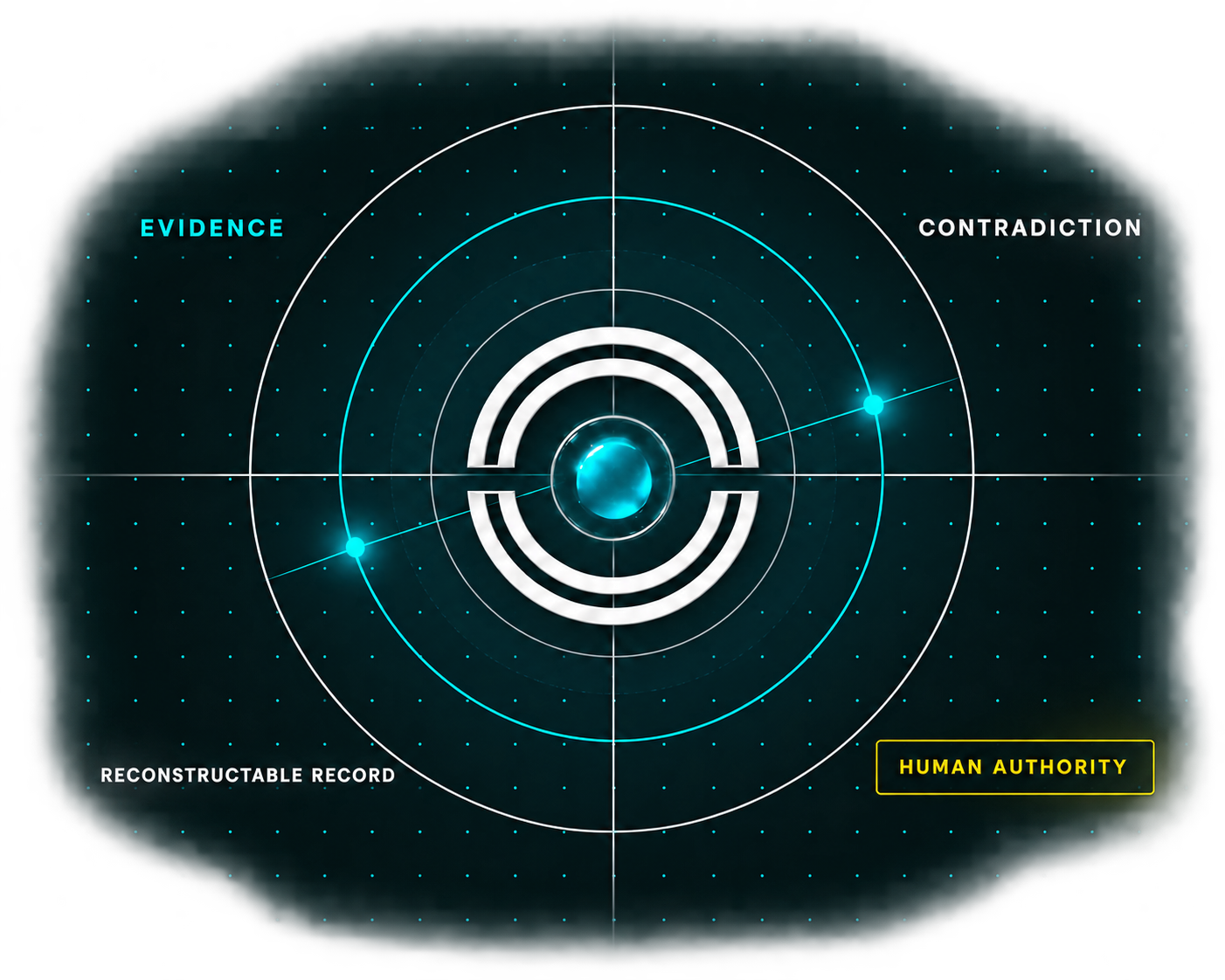
Circular Deduction™ · 6+1 Governed State Architecture
A governed learning system for consequential decisions.
Circular Deduction makes the Decision Basis visible before commitment, keeps Human Authority explicit at consequential gates, and governs what validated learning is allowed to change in the system that will shape the next decision.
Six states govern the decision and its Decision Basis. +1 Reinsert governs what learning is allowed to change in the system that shapes future decisions.
Method explorer · select a stage to learn more
01 / 06
01 · Frame / Decision governance
Say what is being decided, and by whom.
Define the decision, its stakes and scope, the accountable Human Authority, and the conditions that would require reconsideration.
Intended output
A defined decision boundary
What must be true
the decision boundary, materiality, accountable Human Authority, material constraints, evidence needs, and reconsideration conditions are explicit.
02 · Derive / Decision governance
Make the basis inspectable.
Connect the available evidence to the reasoning. Keep assumptions, dependencies, uncertainty and gaps visible alongside the recommendation.
Intended output
An inspectable Decision Basis
What must be true
the Decision Basis is inspectable—evidence, assumptions, dependencies, uncertainty, gaps, and inferential paths are visible.
03 · Contradict / Decision governance
Put the basis under pressure.
Deliberately challenge the case. Preserve material objections, counter-evidence and alternative explanations with their provenance and scope.
Intended output
A documented material challenge set
What must be true
a material challenge set exists with provenance and scope; the basis has been deliberately attacked rather than merely reviewed.
04 · Reconcile / Decision governance
Show what holds, and what remains unresolved.
Give each material contradiction an explicit treatment. Resolve, condition, reject or preserve it, while keeping residual uncertainty visible.
Intended output
Explicit treatment of material contradictions
What must be true
material contradictions are resolved, conditioned, rejected, or explicitly preserved, with residual uncertainty visible.
05 · Commit / Human Authority
Make the accountable human judgment explicit.
The rightful Human Authority records the commitment posture, conditions, authorized boundary and verification requirements. Human Authority also governs other consequential gates throughout the cycle.
Intended output
A recorded commitment posture and its conditions
What must be true
accountable Human Authority records the commitment posture, conditions, authorized change boundary, and verification requirements.
06 · Extract / Decision governance
Preserve what the decision teaches.
Bound the learning and retain the evidence status of each observation or candidate lesson. Identifying a lesson does not authorize a change to policy or the governing system.
Intended output
An evidence-linked learning set
What must be true
the learning set is bounded and each observation or candidate lesson retains its evidence status; no lesson silently becomes policy.
+1 · Reinsert / Governed system adaptation
Decide what learning is allowed to change.
The governed object is now the system that shapes future decisions. Record an explicit disposition for the learning, including a justified decision not to change that system.
Intended output
A governed learning disposition
What must be true
validated learning is either authorized into the governing system through a defined target, authority, implementation mechanism, governing version, enforcement, and verification—or explicitly dispositioned. Automation may execute within granted bounds; it may not enlarge its own authority.
An authorized change identifies its target, rightful Human Authority, implementation mechanism, governing version, enforcement and verification. Automation stays within granted bounds.
Evidence with provenance
Contradictions visible
Human Authority explicit
Reconsideration preserved
This explorer explains the method. Selecting a stage does not advance or authorize a decision. Actual movement depends on evidence, governing conditions and rightful Human Authority; a decision may advance, hold or return.
Circular reasoning returns to its own assumptions for validation. Circular Deduction returns to the governing system only after the Decision Basis has been exposed, contradicted, reconciled, committed, observed, and its learning explicitly dispositioned.
Circular proof
A conclusion ultimately depends on itself for validation. Repetition or prior acceptance adds no independent support.
Governed return
Prior governed state meets new or current evidence, contradiction, reconciliation, Human Authority, observation, and an explicit learning disposition before future state changes.
A prior conclusion may inform a future cycle, but it does not become evidence for itself merely because it survived an earlier one.
Founder language: “calculating the logic curves.” Formally, Circular Deduction treats this as the Decision Trajectory—the reconstructable way the Decision Basis bends as evidence, contradiction, uncertainty, constraints, Human Authority, and observed consequence change. It is a governed reasoning trajectory, not a mathematical prediction claim.
Statefulness
Progress is permission, not activity completion.
Circular Deduction is ordered, but it is not a checklist. Each state defines what must be true; advancement requires the applicable evidence, governing conditions, and rightful authority—not completion of an activity. Unresolved contradictions, insufficient evidence, or authority defects may hold or return the decision for reconsideration.
A step says what to do next.
A state says what must be true before the system is permitted to advance.
A transition changes what the system is entitled to claim about the decision.
Advance
Required conditions are sufficiently satisfied.
Hold
Material conditions remain unresolved.
Return
New evidence invalidates part of the earlier basis.
Disposition
The reason for stopping or adapting is made explicit.
Where the architecture becomes operational
The Method defines the governance architecture. The Cockpit operationalizes it.
The Decision Cockpit™ is the working surface where state, evidence, contradiction, authority, transitions, and learning remain visible rather than disappearing into narrative.
Its interface follows the same governance logic: state before action, evidence before confidence, authority before commitment, and consequence before execution.
What supports the basis, with provenance and uncertainty.
Contradiction
What challenges the basis and remains unresolved.
Human Authority
Who may commit, accept risk, or authorize adaptation.
Decision Basis Record
The reconstructable record explaining how the decision reached its state.
Learning disposition
What was learned and what that learning was authorized to change.
From signal to governed change
Many systems can feed the decision. One governance architecture determines what may advance.
Circular Deduction can begin with a person, a method, or a system. The source may inform the decision. It does not inherit evidentiary status or authority merely because of how it arrived.
People
Customer and reviewer input
Evidence Intake · email · structured review · human observation
Methods
External Governing Systems
Standards & assurance · Law & regulation · Policies & controls · Contracts & obligations · Authority & decision rights · Methods & operating processes · Strategy, risk & investment criteria · Systems of record & evidence sources
Systems
Operational and foresight feeds
API · webhook · telemetry · analytics · AI · forecasting · monitoring
The channel determines how information moves. Circular Deduction determines what that information is permitted to become.
Interoperability
Works alongside the systems you already use.
Circular Deduction does not replace the systems that produce or govern consequential work. External Governing Systems remain external; only bounded decision-relevant objects cross the boundary. Those objects may FEED evidence, HOST analysis, GOVERN within rightful scope, or GATE authorized action.
Source, version, applicability, evidence state, authority, and control effect remain explicit. The objective is bounded interoperability—not universal compatibility, conformity, or authority transfer.
FEED
Supply governed input
External evidence, observations, measurements, or constraints may enter with provenance, scope, classification, and uncertainty preserved.
HOST
Run a technique inside a state
A technique such as FMEA can operate within Derive or Contradict. Running the technique does not satisfy the state by name.
GOVERN
Retain rightful external authority
Policies, obligations, constraints, and existing authority structures remain authoritative within their actual scope; Circular Deduction does not silently replace them.
GATE
Use existing change control
When validated learning requires system change, Reinsert references the rightful authorized change mechanism rather than creating a parallel approval path.
External method completion does not equal Circular Deduction state completion.A tool or method may contribute technique or evidence. It does not independently satisfy state conditions or inherit Human Authority.
Ingress
Email · web forms · Cockpit · files · API · webhooks · event feeds
Learning is governed at two scales: decision-level adaptation through Extract/Reinsert, and architecture-level adaptation through Governed Development under Human Authority.
Technical evolution keeps proposal separate from acceptance, contradiction visible, and consequential change reconstructable.
A consequential decision should leave more than a conclusion.
Decision Basis Record
A reconstructable account of evidence, assumptions, contradiction, authority, uncertainty, commitment, and learning.
Authoritative disposition
Proceed, proceed with conditions, revise, hold, or reject—with accountable authority preserved.
Learning disposition
REINSERTED · PENDING AUTHORITY · NON-REINSERTABLE · NOT YET VALIDATED.
Governance provenance
The governing-system version under which the decision was evaluated and authorized.
Architectural requirement
Every consequential decision is governed against an identifiable version of the governing system so that its Decision Basis remains reconstructable after that system changes.
A future reviewer should be able to determine what was known, what rules applied, who held authority, and why the decision was supportable under the conditions of its time.
A decision can be complete before its learning is closed.
Commit can complete the operational decision while observation and learning continue.
A Circular Deduction cycle closes only when its learning receives an explicit disposition.
Changing nothing can be valid. Failing to decide whether anything should change is not closure.
Proportional governance
The right review starts before Frame.
The Materiality Gate considers the decision and its governing context. Explore seven factors through one fixed example to see what needs to be understood before a review path is established.
Fixed synthetic example
Should the initial infrastructure phase launch?
SYN-LAUNCH-01 · v1.0
How the gate relates to the method
Decision in contextEvidence, scope and governing conditions
Materiality GateClassify before Frame Outside the 6+1 states
Routine → proportionate review
Applicable controls remain in force.
Consequential / Elevated Adaptation → 6+1
Entry and advancement depend on applicable conditions and authority.
Frame
Derive
Contradict
Reconcile
Commit
Extract
+1 ReinsertGoverned adaptation of the system from validated learning
Architecture map only. The gate is not an eighth state; this diagram does not show state completion.
Example classification: not established in the specimen. No route is selected here. Unknown factors remain unknown; selecting an explanation does not classify a decision.
Human Authority disposition
HOLD
Illustrative program sponsor Supplier evidence and concurrence remain open.
Commitment gate
WITHHELD
Actual authorization: none Execution permission: none
Recorded next action · ACT-01
Supplier lead: provide the dated mobilization plan and crew availability evidence.
Due before a new launch recommendation.
Explore a factor
Seven explanations · one unchanged example
Consequence
Launch dependency remains open
What would follow from the decision, including an unsupported commitment.
In this example
Scope and funding are reconciled for the initial phase. Supplier mobilization remains unverified.
Why it matters
A readiness claim alone does not establish that the launch conditions are satisfied.
Evidence or clarification
Identify the affected obligations, delivery exposure and material limits before a new recommendation.
Specimen references: E1 · E2 · E3 · C2
Irreversibility
Reversal constraints not established
What would be difficult or impossible to undo after commitment.
In this example
The specimen grants no spending, contracting or execution authority. Reversal costs are not established.
Why it matters
An unknown reversal burden cannot be treated as evidence that a decision is easy to undo.
Evidence or clarification
Establish the relevant commitments, exit conditions and reversal constraints.
Specimen references: D-01 · Initial-phase scope
Uncertainty
Evidence required
What the decision still depends on that has not been established.
In this example
The supplier readiness claim lacks a dated mobilization plan and crew availability evidence. Resource availability remains an assumption.
Why it matters
The unresolved dependency stays visible. The missing evidence does not prove the supplier claim false.
Evidence or clarification
Supplier lead: provide the dated plan and crew evidence before a new launch recommendation.
Specimen references: E3 · A1 · C2 · ACT-01
Authority sensitivity
Concurrence remains open
Whose decision it is, within what remit, and what concurrence applies.
In this example
The illustrative program sponsor has recorded HOLD. The required concurrence scope and evidence are not yet established.
Why it matters
A named role, a completed review and permission to execute are separate matters.
Evidence or clarification
Establish and record the applicable concurrence before separate sponsor reconsideration.
ACT-02 · Program review lead: assess the new evidence, update the Decision Basis and establish the applicable concurrence route.
ACT-03 · Accountable sponsor: reconsider HOLD only after the updated basis and required concurrence are recorded. The future disposition is not preselected.
Explanatory synthetic specimen. Selectors change the explanation only. No visitor decision is classified, and no authorization or execution occurs.
Apply the method
Start with one consequential decision.
Bring one consequential decision. Circular Deduction makes evidence, contradiction, Human Authority, commitment, and the record of change explicit before broader work is considered.