Make uncertainty, evidence, governing context, and Human Authority visible—without promising certainty or replacing human judgment.
What Circular Deduction does
Pressure-test the decision before commitment.
See what supports the decision, what remains unresolved, and what must happen next—with evidence, Human Authority, and next actions linked in the record.
Aegis assists. ECOS governs.Accountable Human Authority retains the decision.
One decision. Four engagement steps. Explore a fixed example in any order.
Illustrative example · initial-phase infrastructure launch · SYN-LAUNCH-01 v1.0 · no live decision or record is changed
EXPLANATION 01
Bring the decision
Begin with a bounded decision.
Decision
Whether to authorize the initial phase of an infrastructure launch.
Why it matters
A launch commitment creates cost, schedule and delivery exposure.
Accountable owner
Illustrative program sponsor, with required specialist concurrence.
Commitment point
Before issuing a launch authorization; no calendar date is invented.
EXPLANATION 02
Define review conditions
Agree what the review must establish.
Materiality
Cost, schedule, operational and safety consequences of a premature launch.
Scope
This initial-phase launch decision and its supplier dependency.
Authority
The accountable sponsor’s decision rights and required concurrence.
Evidence needs
A confirmed scope, funding status, supplier readiness and applicable requirements.
Handling constraints
Use permitted evidence, limit access and agree record handling before review.
EXPLANATION 03
Run the review
Make the basis and its tensions inspectable.
Evidence examinedScope, funding, requirements and supplier claims are distinguished from verified readiness.
C1 · Resolved in this exampleA dated scope reconciliation explains the apparent funding mismatch. Its history remains in the record.
C2 · Unresolved, bounded in this exampleSupplier mobilization is unverified. The condition is traced to the launch dependency; execution remains withheld.
The 6+1 cycle remains the method. These four explanations describe engagement; they do not replace its states. Examine the method.
EXPLANATION 04
Leave with the next move
An explicit disposition, with actions that can be followed.
Human Authority · illustrative program sponsor
Authority is limited to the launch decision, subject to applicable approval and risk requirements. This public example grants no permission.
Illustrative Human Authority disposition: HOLD The sponsor withholds launch authorization because supplier readiness is unverified and required concurrence remains open.
Recorded next actions
Supplier lead
Provide a dated mobilization plan and evidence of crew availability before a new launch recommendation.
Program review lead
Check the evidence against the launch scope, update C2 and the Decision Basis Record, and establish the applicable concurrence route before sponsor reconsideration.
Accountable sponsor
Reconsider the hold when the updated basis is ready and required concurrence is recorded. No launch is authorized in the meantime.
Snapshot: state and conditions at a recorded point in time. Decision Basis Record: evidence, tensions, governing context and authority status. Both remain useful while a decision is held.
Consequential Decision Lifecycle
Trace how a consequential decision becomes governed and reconstructable.
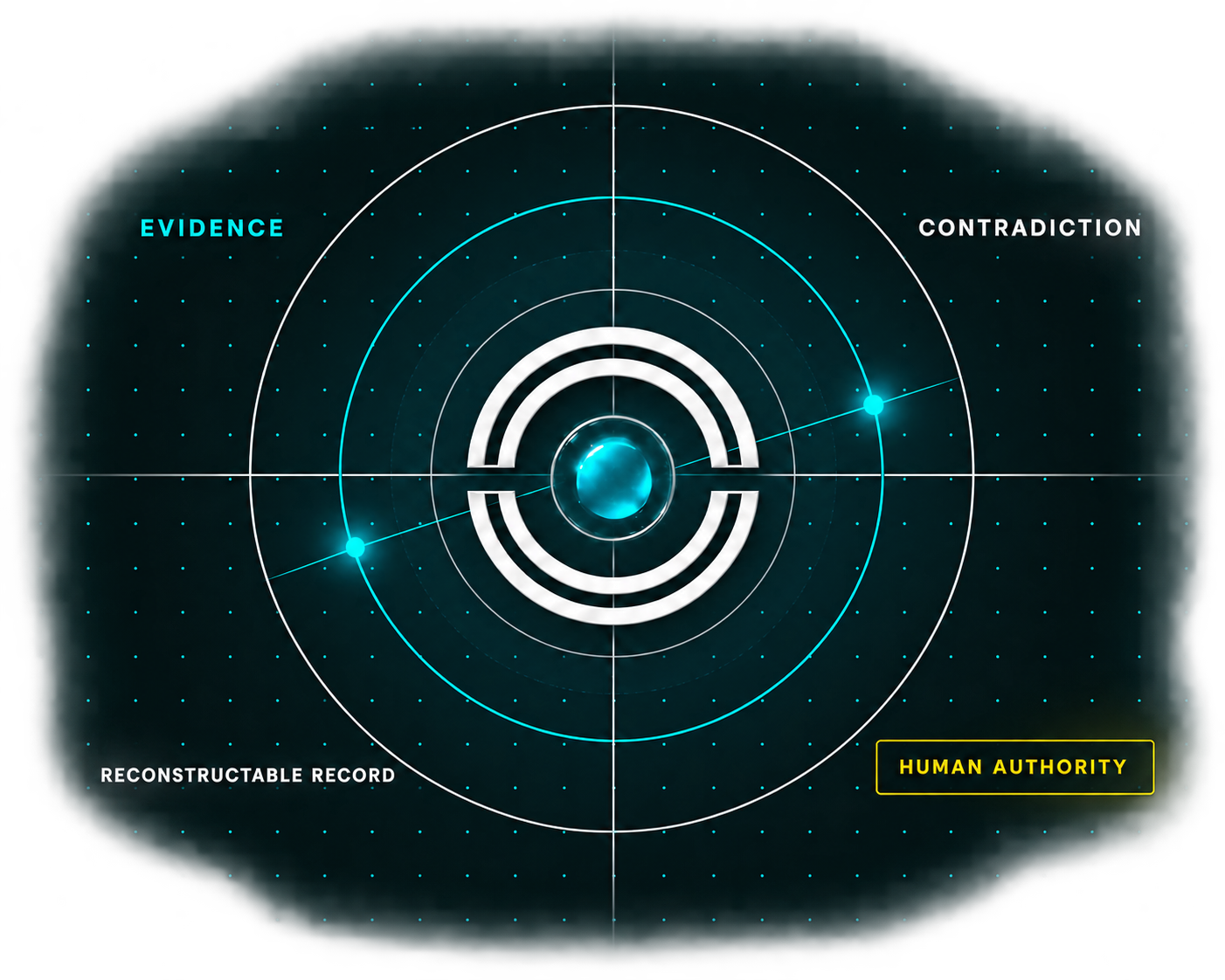
It makes six transitions visible: evidence, contradiction, reconciliation, Human Authority, commitment, and a Decision Basis Record.
01
Evidence
What supports the decision—and what is merely assumed?
02
Contradiction
What materially challenges the current model?
03
Reconciliation
What still holds after the evidence and conflict are tested?
04
Human Authority
Who is accountable to authorize, accept risk, and decide?
05
Commitment
What is actually authorized, owned, and expected to change?
06
Decision Basis Record
Can another competent reviewer explain how this decision reached its current state?
Human Authority Boundary — analysis may inform; accountable humans authorize and commit.
This governed decision lifecycle complements, rather than replaces, the canonical 6+1 architecture: Frame → Derive → Contradict → Reconcile → Commit → Extract, with +1 Reinsert governing adaptation.
THE DECISION BASIS · MADE VISIBLE
See the decision basis come into focus.
Five comparisons. One fixed example. The basis becomes inspectable; unresolved conditions stay visible.
Synthetic example · initial-phase infrastructure launch · SYN-LAUNCH-01 v1.0
EXAMINED BASIS · OPEN CONDITIONS RETAINED
Human disposition
HOLD
Illustrative program sponsor
Commitment gate
WITHHELD
No launch is authorized
Recorded next action · Supplier lead
Provide a dated mobilization plan and crew evidence before a new launch recommendation.
01Sources
Sources linked; limitations visible
E1–E4 distinguish scope, funding, the supplier’s readiness claim and governing requirements.
02Assumptions
Assumptions explicit; verification status shown
A1 · Resource availability is assumed. Verification remains open.
03Contradictions
Dispositions recorded; open conditions retained
C1 is resolved with its history preserved. C2 remains unresolved: supplier mobilization is unverified.
04Human Authority
Accountable authority, remit and disposition recorded
The illustrative program sponsor holds the initial-phase launch decision. Required concurrence remains open.
05Reconsideration
Residual uncertainty and reconsideration triggers documented
Missing supplier evidence and four recorded triggers define what must be revisited. A clearer basis does not guarantee the outcome.
5 of 5 comparisons revealed
These controls change the explanation only. Selecting a row reveals it and all preceding rows. Human disposition HOLD, gate WITHHELD and recorded next actions do not change.
Required concurrence also remains open. Reconsideration requires an updated basis and a separate Human Authority decision.
The starting phrases describe common review gaps, not a prior recorded state of this specimen. Revealing a comparison does not perform a review or change the decision.
Where It Applies
Govern the decisions that determine whether the work succeeds.
Circular Deduction does not replace the External Governing Systems around consequential work. It governs the decision across them.
Project & Program Decision Review — stage gates, change control, vendor choices, program recovery, risk acceptanceInfrastructure & Capital DecisionsVendor & Procurement DecisionsExecutive & Strategy DecisionsIncident & Resilience DecisionsAI-Assisted Decisions
A bounded application of the method to one consequential decision. The goal is a visible, reconstructable basis for action—not certainty.
Define the decisionSurface material assumptionsMap evidence and contradictionClarify authority and risk boundariesIdentify what would change the conclusion
Scope first. Commitment later.
Services are bounded to agreed scope. Outputs explain the decision basis and limitations; they do not guarantee outcomes.
Design, internal testing, independent review, operational evidence, and client outcomes are distinct evidence states.
Architecture Underneath
Depth when you need it.
Circular Deduction remains the method. ECOS governs state. The Decision Cockpit™ is the common operating surface—making current state, governing condition, Human Authority, and the next permitted action legible without flattening the underlying complexity.
External Governing Systems can contribute bounded inputs without inheriting authority. The Decision Basis Record preserves what held—and why. Aegis assists where authorized; accountable humans retain authority.