Scope & gate decisions
Is the project ready to advance?
Make evidence sufficiency, assumptions, unresolved contradictions, decision authority, and conditions of advancement visible.
Project systems manage plans, schedules, costs, risks, deliverables, and reporting. Circular Deduction governs the consequential decisions made with that information.
It is most relevant when capital, vendor commitments, risk acceptance, operational readiness, or hard-to-reverse change are at stake.
Initial fit is infrastructure-heavy and high-consequence work. Circular Deduction supplements—not replaces—project-management frameworks, PMOs, stage gates, risk registers, or accountable governance bodies.
Project information does not authorize action by itself. A material decision still needs an inspectable basis: what evidence supports the action, what contradicts it, which assumptions remain open, who has authority, what is being committed, and what would require reconsideration.
The method is most useful before a team spends capital, binds a vendor, accepts residual risk, enters service, approves material change, or closes an incident whose consequences may persist.
Make evidence sufficiency, assumptions, unresolved contradictions, decision authority, and conditions of advancement visible.
Separate scoring, technical evidence, commercial pressure, risk allocation, exceptions, and accountable selection authority.
Distinguish recommendation from authorization, and make residual risk, owner, conditions, and escalation explicit.
Expose cumulative scope, cost, schedule, technical, and authority effects before incremental approvals become unexamined drift.
Connect commitment to observed state, verification, residual gaps, closure authority, and conditions that prevent premature acceptance.
Preserve changing evidence, bounded actions, corrective commitments, verification, and recurrence triggers without treating task completion as proof of resolution.
The 6+1 governed state architecture does not change for project work. The project context changes the evidence, stakeholders, authority, and consequence—not the method. Existing delivery systems continue to manage the work; Circular Deduction governs the consequential decision inside them.
A Consequential Decision Review reconstructs one bounded decision, tests the evidence and authority boundary, and produces a decision package that can be challenged and revisited. It is a contained review step—not a commitment to replace the project system or adopt broader software.
What is being decided, by whom, under what constraints, and on what horizon.
What supports the recommendation, what conflicts, what is assumed, and what remains materially unresolved.
Who may recommend, approve, execute, verify, accept risk, and authorize closure.
What still holds after contradiction, including conditions, limitations, and what would change the recommendation.
A Decision Basis Record connecting evidence, authority, commitments, verification, residual risk, and disposition.
Defined evidence, thresholds, recurrence, or changed conditions that require the decision to be reopened.
Project and program managers, technical leads, procurement teams, operational leaders, and other practitioners who assemble the evidence but should not be forced to carry authority they do not own.
Bring one material decision, why it matters, what is known, where the evidence conflicts, and what a useful decision package must clarify. Sensitive information should wait for an authorized channel.
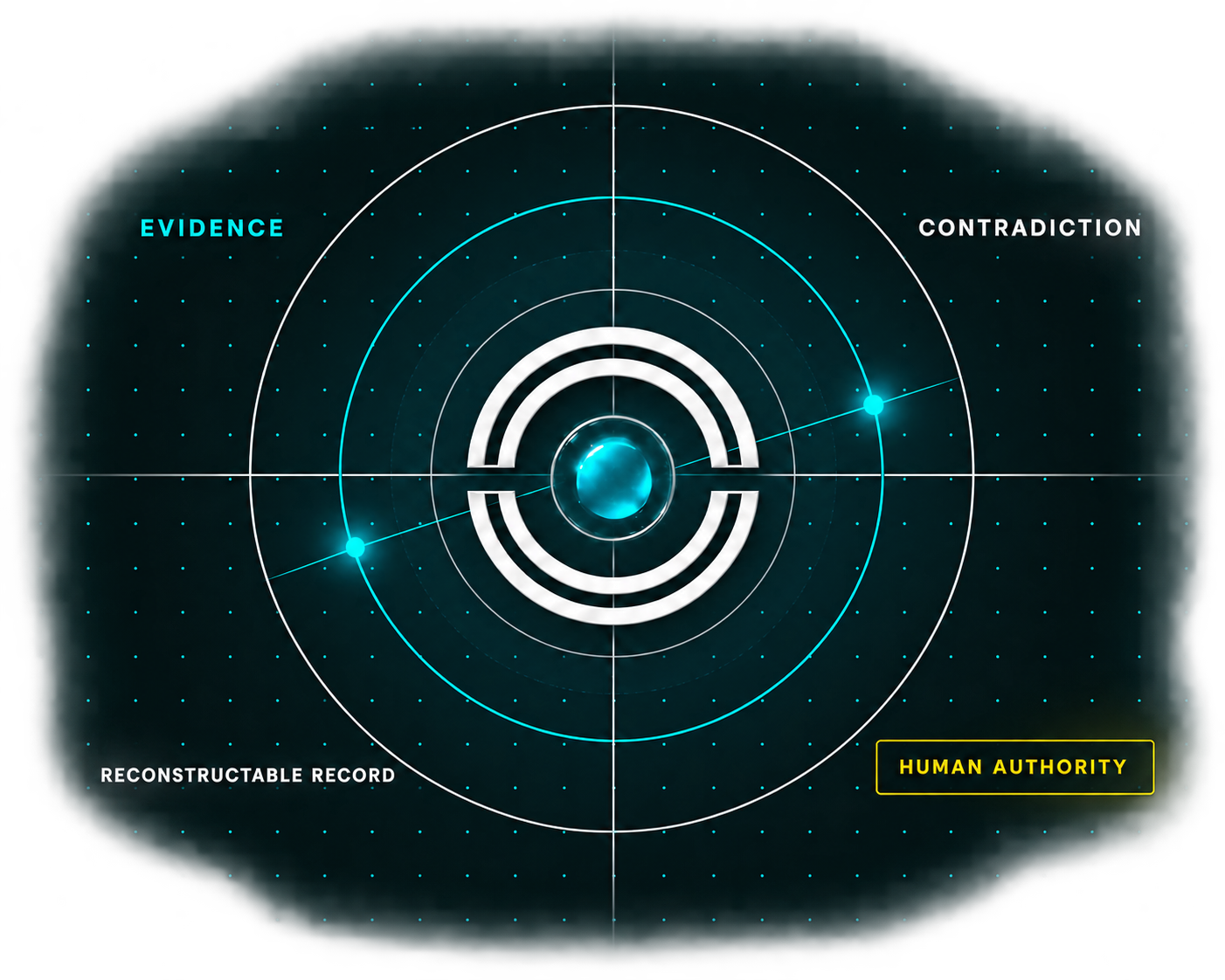
Follow one public-safe decision through evidence, contradiction, reconciliation, Human Authority, commitment, and a reconstructable record.